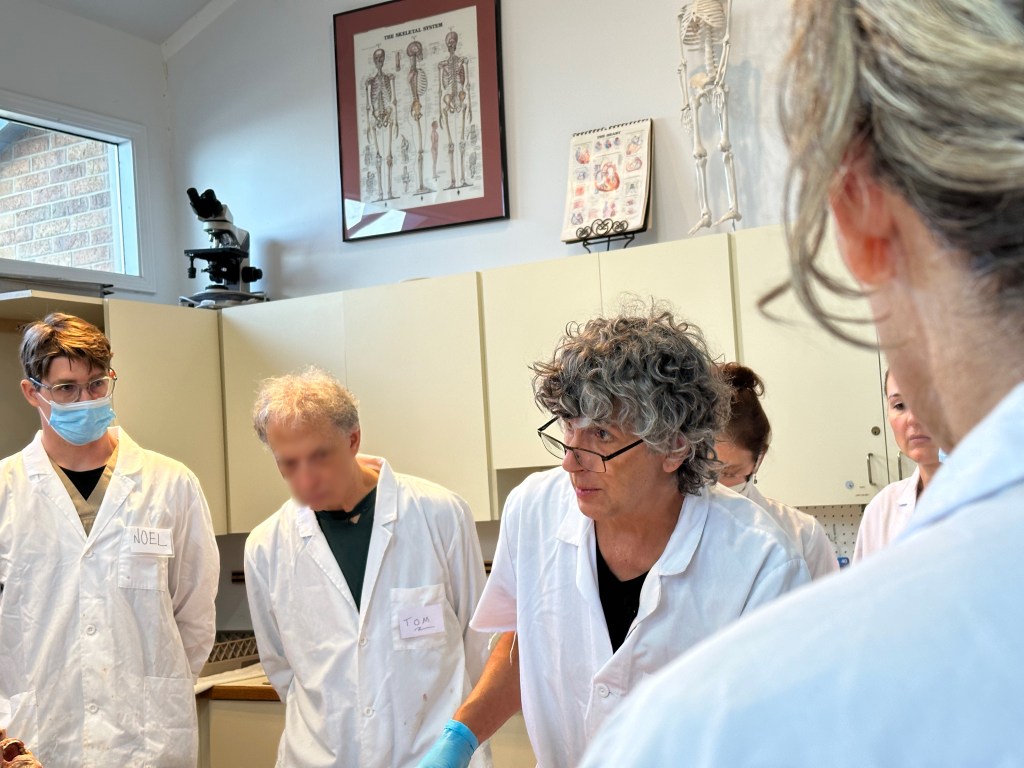
Today I met the legendary Dr. Hedley, the Fuzz Speech Guy, and our cadaver “Tony” at an undisclosed location (out of respect to the donors). Entire class consists of about 30 people. My team includes two structural integrators (a Rolfer and a KMIer), a Pilates teacher, and a massage therapist.
I will spend 8 hours/day, 6 days a week, for three weeks to learn who I am with Tony.
What I leaned today:
Skin color is not even epidermis deep.
When you stand cadavers up, they look happier and you feel them more personal.
Cadavers go where their hips go.
An Invisible and inaudible bell works as well as a visible one
Hands and feet are as personal as faces.
Once I get used to, my brain re-calibrates for through-the-exam-gloves touch and I can feel detailed texture just like with direct contact.
Gil calls a cadaver human “form.”
Holding each form in the standing position revealed the story we didn’t see when they were lying on the table. How the body occupies the space is an integral part of who they are. Standing makes them look closer to the life. One female form was surprisingly tall with dancer’s legs. Standing, she looked younger and livelier. Personality of the form takes shape through interaction with the gravity. Narrative emerges from the relationship of the body with gravity in space.
Integral Anatomy Workshop is an intensive hands-on human dissection workshop for manual therapists/structural integrators/body workers/philosophers. It’s quite different from medical school gross anatomy lab classes.
Dissection is an act of introspection. By unwrapping the layers of the donor’s gift, participants uncover hidden layers of themselves. Gil Hedley, Ph.D.
The Gross Anatomy Lab is super clean.
The lab is super clean. The color scheme is: whitish linoleum floor; white lab coats; black counter tops; black chairs; orange cabinets, and lots of stainless steel glare under fluorescent light.
We spent about 7 hours in this totally artificial sanitized space with continuous humming of some kind of machines in the background.
Day 1 is for observation. No scalpel. We spent long time with Tony, taking notes of surface marks, such as surgical scars. Most of the students are one kind of manual therapists or another. Our way to relate is distincti
2018年にベルリンで開催された第5回国際ファシア学会会議(Fifth International Fascia Research Congress)で発表されたプレゼンテーションビデオです。ギル・ヘドレー博士が、「ファズ」(Fuzz)と呼んでいたファシアとは何かについて説き明かします。まず、皮下脂肪層、そして疎性結合組織を示し、いずれも、2015年ファシア学会会議で提案された定義に適合するファシアとして実証することができることを示します。一般に疎性結合組織と考えられている組織の名前として、表層ファシア(Superficial fascia)とペリファシア(perifascia)を提案します。
「毛羽立ち(Fuzz)」は、実際には生体内の非常に湿った膜であり、私は現在「ペリファシア」と呼び、解剖学者は一般に疎性結合組織(loose areolar connective tissue)と呼んでいるものです。 私がこれをファシアと呼んで妥当であると考えるのは、それが結合組織の集合体であり、覆い、包み込み、シート状に剖出することができるためです。シート状に切り出すのは容易であり、私も他の多くのビデオでも行っています。 解剖時に引き裂くと「毛羽立った」ように見えるのは、それを構成するコラーゲン線維の組織が直線的ではなく「フェルト状」に組織されているためで、非生理的張力がかかると綿菓子ように毛羽だちます。 これらの組織は、筋骨格系の中で特に差異運動(differential movement)が発生する場所に存在します。 これらは滑りやすく湿っており、膨張性と弾力性があるため、これらの膜を介して関係する他の組織(筋束など)が作用し、相互に簡単に移動できます。 感覚神経終末もこれらの組織で終結しており、これらの滑りやすい経路を通って他の目的地に向かう多くの神経も存在します。 したがって、ペリファシア膜組織が静止状態、脱水状態、虚血状態、および/または炎症を起こしている場合、実際にそこが痛みの原因となる可能性があります。 私は、「What’s the Fuzz?! The role of Fascia in Healthy Movement」という一連のビデオで、研究室の画像や映像を使ってこれらの組織について詳しく議論し、説明しています。このビデオは私のウェブサイトで(https://www.gilhedley.com/products/what-s-the-fuzz-5-hr-ce-credit-course)見つけることができ、視聴できます。 イージーライダー会員(無料)に登録し、楽しんでください!
Gil Hedley, Ph.D.
浅層ファシア:Superficial fascia
Fascia is all round us!のビデオはまず、浅層ファシア(superficial fascia)の性質のデモンストレーションから始まります。浅層ファシアは密性結合組織である真皮(dermis)と筋肉の間にある層であり、皮下脂肪層のことです。人体解剖図やビデオでは皮下脂肪層に焦点が当てられることは希であり、その存在はしばしば悪者や排除すべきものとして扱われており、これまで皮下脂肪層が果たす重要な役割や機能について言及されることはまれでした。





 解剖実習のすすめ